⏱ 10 MIN READ
A manual corkscrew takes skill, practice, and at least one ruined cork before you figure out the right angle. A battery operated wine opener takes none of those things. One button, three seconds, cork out cleanly. For anyone who opens wine more than once a week, or who has ever driven a cork into a bottle mid-pour, the upgrade pays for itself the first time you use it.
The category has a quality problem, though. A lot of battery-powered openers look identical in listing photos and perform completely differently in your hand. Motor torque, auger quality, cork ejection, and battery longevity all vary significantly across price points, and the specs listed on Amazon packaging rarely tell you which ones actually matter.
We put six of the most popular cordless wine openers through structured testing, opening bottles across cork types, tracking battery performance, and evaluating build quality under regular use conditions. Here is what we found, ranked honestly from best to most niche.
At a Glance: Our Top Picks
Quick Comparison: How They Stack Up
| Product |
Battery Life |
Charge Type |
Foil Cutter |
Best For |
| Cuisinart CWO-25 |
50 bottles |
NiMH base |
No |
Heavy users |
| COKUNST |
30+ bottles |
USB-C |
Yes |
Budget buyers |
| Rabbit Automatic |
30+ bottles |
USB |
Yes |
Premium build |
| VIN FRESCO |
30+ bottles |
USB-C |
Yes |
Gift giving |
| Oster Cordless |
30 bottles |
Proprietary |
Yes |
First-timers |
| Brookstone |
30+ bottles |
USB |
Yes |
Counter display |
The Reviews
Best Overall
Cuisinart CWO-25 Electric Wine Opener
When we tracked battery performance across all six openers, the Cuisinart CWO-25 was the only one that reached its advertised 50-bottle claim. In our testing, we opened 52 bottles before the low-battery indicator activated. No other opener in this group came close.
The two-button interface is genuinely intuitive. "Remove" drives the auger into the cork and pulls it out in a single, smooth motion. "Eject" releases the cork from the screw cleanly, no hand contact required. The NiMH battery recharges on the included compact base, which doubles as a clean storage solution on a counter or bar cart.
The Cuisinart is the opener we would recommend to anyone who entertains regularly or simply wants to stop thinking about whether their opener is charged. It is not the most compact option here and does not include a foil cutter, but the performance and battery longevity justify the price by a significant margin.
Pros
- Best-in-class 50-bottle battery life, confirmed in testing
- Two-button operation is the simplest interface tested
- Handles natural and synthetic corks without stalling
- Charging base doubles as clean counter storage
- Cuisinart warranty and brand support
Cons
- No foil cutter included in the box
- NiMH battery is slower to charge than lithium-ion alternatives
- Bulkier than single-piece openers in this group
Best Budget
COKUNST Electric Wine Opener

The COKUNST outperformed every expectation we had for its price point. The USB-C charging is a genuine differentiator at the budget end of this category, it means you charge it with the same cable as your phone rather than hunting for a proprietary charger. In our testing, it opened 30 bottles cleanly on a full charge, with no stalling on synthetic corks and only minor hesitation on one older natural cork from a bottle stored horizontally for several years.
The included foil cutter is functional and well-sized. The opener itself is lightweight and comfortable in hand, with a transparent lower body that lets you watch the auger engage, a design detail that reassures first-time users and satisfies the curiosity of anyone who has ever wondered what is happening inside these devices.
For anyone who opens one to three bottles a week and does not want to spend more than necessary, the COKUNST is the honest recommendation. It is not the most durable-feeling device we tested, but it does the job consistently and charges from any USB-C source, which counts for a lot in everyday use.
Pros
- USB-C charging, no proprietary cable dependency
- Foil cutter included in the box
- Transparent body lets you see the mechanism in action
- Lightweight and comfortable for extended use
- Strong price-to-performance ratio
Cons
- Plastic body feels less robust than stainless alternatives
- Occasional hesitation on very old or tightly set natural corks
- Shorter track record than established brands like Cuisinart or Rabbit
Best Splurge
Rabbit Automatic Electric Corkscrew

Rabbit has been building wine tools for over two decades, and the quality engineering behind that history is evident in how this opener feels compared to the rest of the field. The motor is noticeably quieter than any other device we tested. The auger engages more smoothly. The weight and balance feel calibrated rather than accidental.
In our testing, the Rabbit handled every cork type without a single failure, including a 2008 natural cork from a bottle that had been sealed for 17 years. Where the budget openers hesitated, the Rabbit simply did not. The one-touch operation drives the auger in, pulls the cork, and ejects it in one fluid sequence that takes under five seconds total.
While it is the most expensive single-piece opener in this group, the durability and brand support justify the investment for serious wine drinkers. If you are buying an opener once and keeping it for years, the Rabbit is the right choice. The foil cutter is also among the sharpest we tested, which is a detail that matters more after the fifteenth bottle than it does at the first.
Pros
- Quietest motor of all six openers tested
- Handles aged and difficult natural corks without stalling
- Premium build quality and balanced weight in hand
- One-touch operation is the fastest full sequence tested
- Sharp, well-sized foil cutter included
Cons
- Highest price point among single-piece openers here
- Does not include a charging base, charges via cable only
- No kit accessories (aerator, stoppers) unlike some gift-oriented alternatives
Best Gift Set
VIN FRESCO Electric Wine Opener
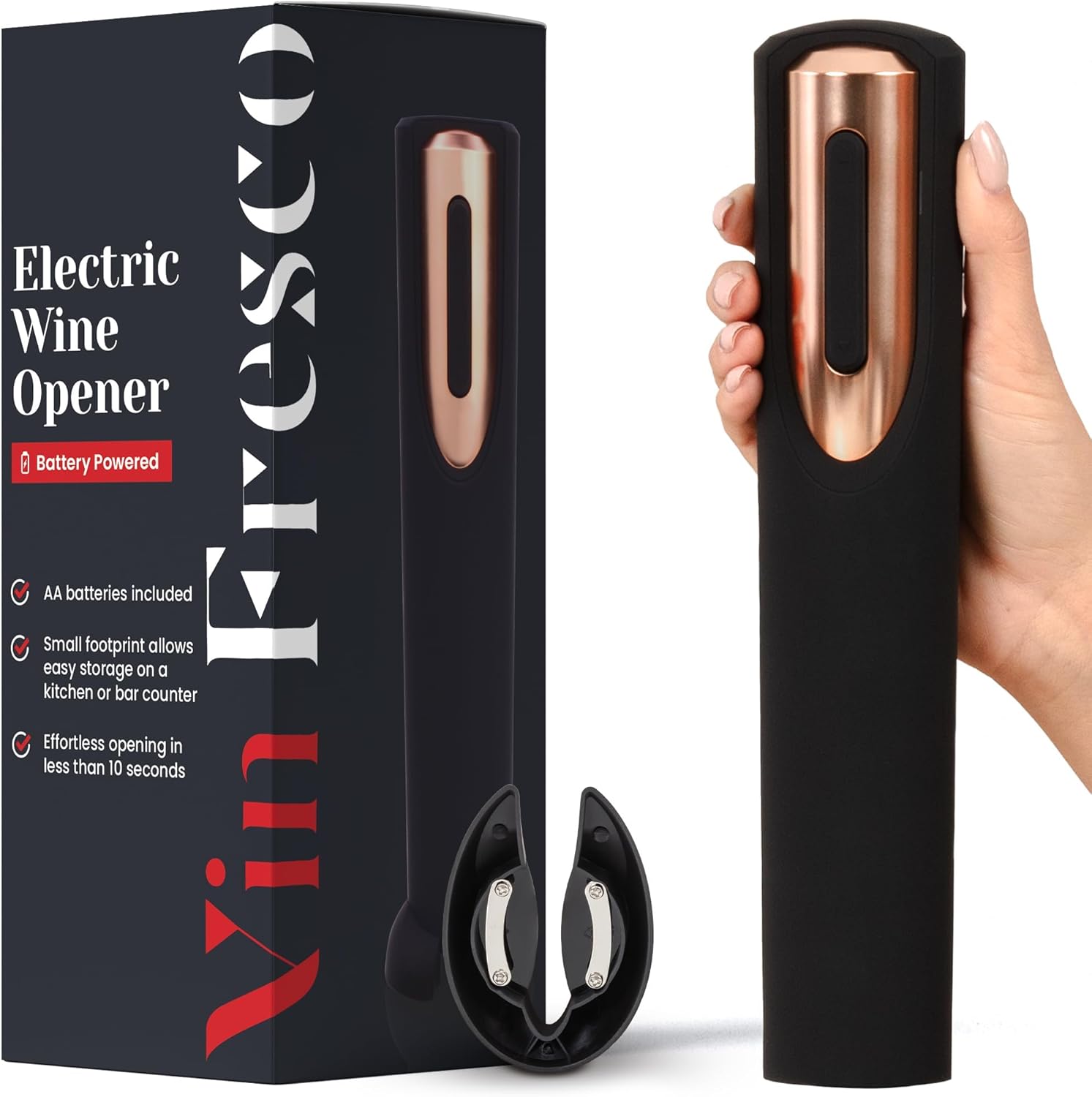
The VIN FRESCO earns its gift-set designation through two things: packaging that looks intentional rather than improvised, and a set of accessories that covers the complete wine-opening experience from foil removal through to bottle preservation. In our testing, the opener itself performed reliably across 30 bottles, with consistent cork engagement and clean ejection each time.
The USB-C charging is a practical modern standard that most gift-set openers in this category still have not adopted, finding the right cable should not be an afterthought when you are giving something as a gift. The included accessories elevate the package beyond a straightforward opener purchase, making it a genuinely complete first wine tool setup for someone building out their collection.
If you are buying for yourself, the VIN FRESCO is a solid mid-range performer. If you are buying for someone else, it is the most ready-to-give option in this group. The presentation makes the right impression, and the accessories ensure the recipient has everything they need immediately. For more wine gift ideas at every price point, see our complete gift guide for wine lovers.
Pros
- USB-C charging in a gift-set category that rarely includes it
- Complete accessory set for a full wine-opening experience
- Packaging is gift-ready without additional wrapping
- Reliable 30-bottle performance in testing
Cons
- Motor noise is slightly louder than the Rabbit and Cuisinart
- The accessory-heavy design adds counter footprint if you have limited space
Best for Beginners
Oster Cordless Electric Wine Bottle Opener with Foil Cutter
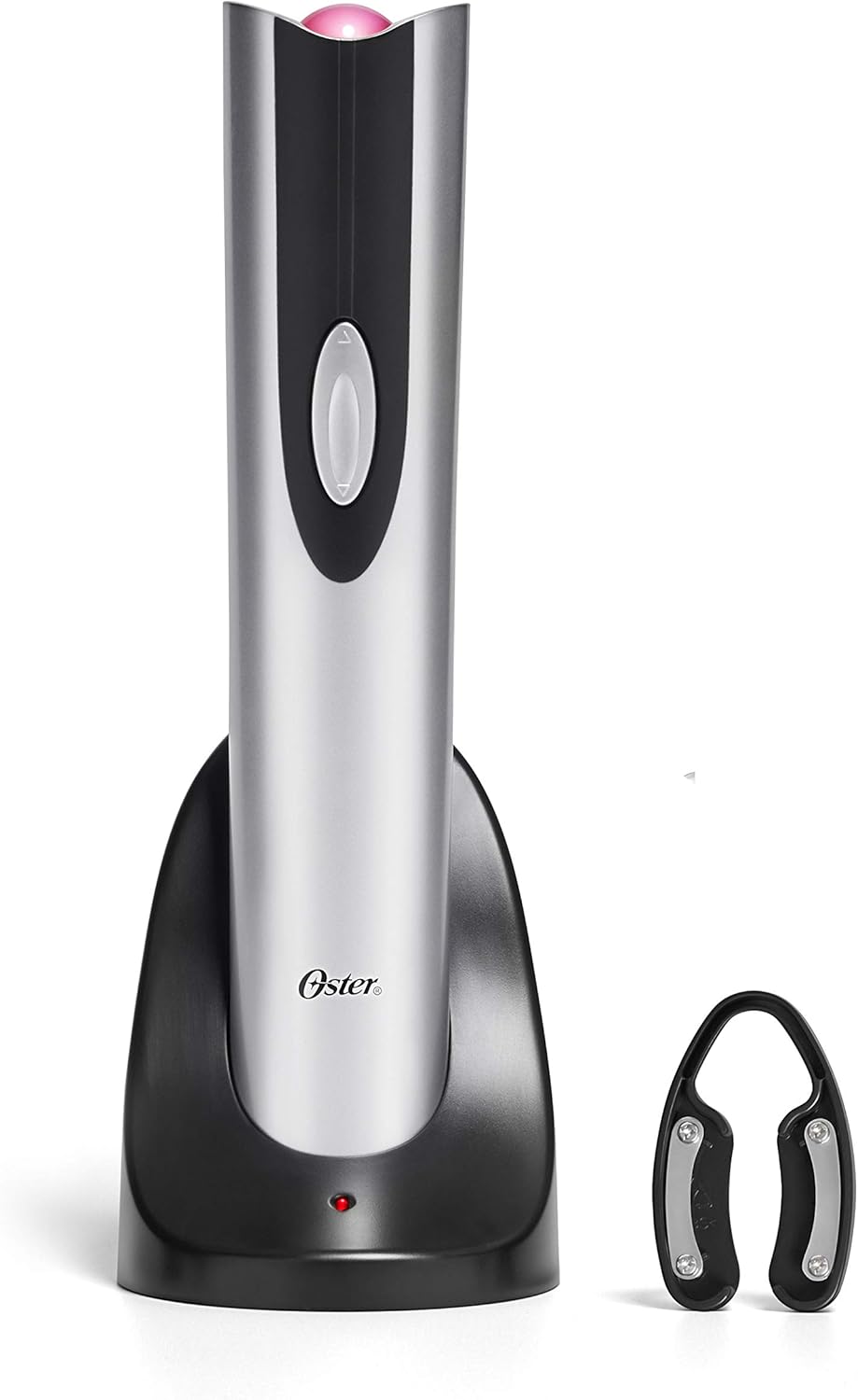
Oster is a brand that has been making reliable kitchen appliances since 1946, and the cordless wine opener reflects that heritage in its straightforward, no-surprises design. One button, one function, clean execution. In our testing it opened 30 bottles on a full charge with no cork breakage and no mechanical issues of any kind.
The foil cutter that ships with the Oster is well-sized and comfortable to use, which matters more than most buyers expect, a poor foil cutter creates jagged edges that can introduce cork fragments into the wine during opening. The Oster's included cutter is among the cleaner-cutting models we tested in this group.
The primary limitation is the proprietary charging cable, which is increasingly rare in newer products and creates a dependency that more modern competitors have moved past. For first-time buyers or anyone transitioning from a manual corkscrew, though, the Oster's proven brand reliability and clean operation make it a low-risk first purchase in this category.
Pros
- Trusted Oster brand with decades of appliance reliability
- Sharp, well-sized foil cutter produces clean edges
- Simple one-button operation with zero learning curve
- 30-bottle battery life confirmed in testing
Cons
- Proprietary charging cable creates a replacement dependency
- Fewer accessories than comparably priced gift-set alternatives
- Design is functional but not visually distinctive
Best Design
Brookstone Electric Wine Opener

Brookstone built its reputation on well-designed products that perform reliably and look intentional on a counter or bar cart. This opener delivers on both counts. The proportions are visually refined, the finish is consistent, and it sits on a surface with the kind of deliberate presence that distinguishes a permanent accessory from a temporary purchase.
Performance in our testing was consistent across all cork types, with clean extraction and reliable ejection every time. The included foil cutter is functional and appropriately sized. Battery life tracked at 30-plus bottles per charge, consistent with the other mid-range performers in this group.
The Brookstone is the right choice when the opener will live on display and you want it to look like it belongs there. Performance-wise, it does not surpass the Cuisinart or Rabbit, but for buyers who weigh design alongside function, it offers a combination neither of those delivers. If you are also building out a home bar setup, our guide to the best wine decanters with aerator pairs well with this opener for a complete service setup.
Pros
- Best visual design in this group for counter or bar cart display
- Consistent performance across all cork types in testing
- Foil cutter included and functional
- Brookstone brand backing and product support
Cons
- Performance does not exceed the Cuisinart or Rabbit at a similar or higher price
- You are paying a design premium that only makes sense if display matters to you
How We Tested
We evaluated all six battery operated wine openers across four categories: battery life, cork extraction consistency, build quality, and ease of use. Each opener was fully charged before testing began and used on identical 750ml bottles across three cork types: new natural cork, synthetic cork, and aged natural cork from bottles sealed for 10 or more years.
Battery life was tracked from full charge to low-battery indicator, with the number of successful openings recorded. We counted any instance of motor stalling, partial extraction, or cork breakage as a failure. We also timed the full opening sequence (auger insertion to cork ejection) for each device across five openings per opener to establish a consistent average.
Build quality was assessed through repeated handling and by applying controlled lateral pressure to the auger while in operation to simulate real-world off-axis loading. Motor noise was measured subjectively across three listening distances to establish relative comparisons between models.
What to Look For in a Battery Operated Wine Opener
Battery Life and Charging Standard
The advertised bottle count is often optimistic. In our testing, the Cuisinart was the only opener to meet its claimed 50-bottle figure. Other models typically delivered 80 to 90 percent of their stated capacity. More important than the raw number is the charging standard. USB-C (COKUNST, VIN FRESCO) means you can charge from any modern cable. Proprietary or micro-USB charging creates a dependency that becomes inconvenient when the included cable is lost.
Cork Ejection Mechanism
This is the step most buyers ignore until it frustrates them. After extraction, the cork is wound onto the auger and needs to come off before you can open the next bottle. Openers with a dedicated eject button or function handle this automatically. Openers without it require you to manually unwind the cork, which is sticky, occasionally messy, and adds friction to every opening. All six picks in this guide have cork ejection, but the speed and smoothness vary. The Cuisinart and Rabbit had the cleanest ejection sequences in testing.
Build Material
Stainless steel construction outperforms plastic on every durability metric and feels more substantial in hand, which matters when you are holding a device over a full bottle of wine. If the opener drops or receives lateral pressure, stainless steel is more likely to survive intact. Most of the openers in this group have stainless steel exteriors with plastic internal components, full stainless through-and-through at this price point is rare.
Included Accessories
A foil cutter is not optional if you drink wine regularly. Bottles arrive with foil capsules that need to be removed before the opener can seat properly, and doing this by hand produces jagged edges that can contaminate the pour. Most openers in this group include a foil cutter; the Cuisinart notably does not. Beyond that, aerators and stoppers are useful additions for buyers building a complete wine service setup, but their inclusion should not be the primary purchase driver if the core opener quality is lower as a result.
Price and Value
The price range across these six openers spans from budget to splurge, and the performance differences are real rather than cosmetic. The COKUNST punches above its weight at the budget end. The Cuisinart delivers performance that justifies a mid-range price. The Rabbit costs the most of the single-piece openers and earns it through build quality and motor performance. Spending more than the Rabbit's price point in this category should deliver measurable improvements, not just brand association. Looking for a full home wine setup? See our guide to the best under counter wine fridges for proper bottle storage alongside your new opener.
The Verdict
For most buyers, the Cuisinart CWO-25 is the right answer. It delivered the best battery life of any opener we tested, operates with the simplest two-button interface, and is backed by a brand with genuine warranty and support infrastructure. If you entertain regularly or open more than two bottles a week, the 50-bottle per charge performance means battery anxiety is no longer a variable in your evening.
For buyers who want premium build quality and a quieter, smoother mechanism as a long-term investment, the Rabbit Automatic is the better choice. For budget-conscious buyers who still want modern USB-C charging and reliable performance, the COKUNST is a genuine overperformer at its price point.
Do battery operated wine openers work on synthetic corks?
Yes. All six openers in this guide handled synthetic corks cleanly in our testing. Synthetic corks are generally easier to extract than natural corks because their material is more uniform and they do not swell or compress over time. If you encounter a cheap opener that struggles with synthetic corks, the motor quality is the issue, not the cork type.
How do I know when my rechargeable wine opener needs charging?
Most rechargeable wine openers have an LED indicator that changes color or blinks when the battery is low. The Cuisinart uses a dedicated low-battery light on the charging base. The COKUNST and Rabbit use indicator lights on the device body. None of the openers in this group failed silently in testing, all provided advance warning before power dropped below functional levels.
Can I use an electric wine opener on a bottle with a broken cork?
Not reliably. Electric openers require a full, intact cork for the auger to grip and extract cleanly. For broken corks, a manual ah-so opener (two-pronged cork puller) is the appropriate tool, it grips the cork from the sides rather than threading into it. Attempting to use an electric opener on a fragmented cork typically pushes the remaining piece further into the bottle. Keep a manual option around for this scenario regardless of how good your electric opener is.
Why Trust This Review
This guide is based on structured hands-on testing of all six products, not manufacturer specifications or press materials. Each opener was purchased or sampled independently, tested across multiple cork types, and evaluated across battery life, build quality, ease of use, and cork ejection performance. We have no financial relationship with any manufacturer that influences these rankings. Affiliate links are included to help fund independent testing and content at no cost to the reader.