Cart
0

If you've ever held a glass wine decanter up to the light and seen a ring of purple residue at the base that hot water and dish soap couldn't touch, you're not doing anything wrong. You're just using the wrong method.
Most people searching for how to clean a stained wine decanter assume the answer involves a special brush, a soak overnight, or some professional cleaning product. The answer is actually simpler — and it's almost certainly sitting in a drawer somewhere, or available for under $15 on Amazon. By the end of this guide, your decanter will be cleaner than the day you bought it.
Quick Summary
Two methods cover every cleaning scenario: stainless steel cleaning beads for deep stains and intricate shapes, and white vinegar with raw rice for a pantry solution that handles lighter buildup. Both are gentle on glass, neither leaves residue, and both take under five minutes. The products and step-by-step process for each are below.

Why Your Decanter Looks Foggy (And Why Soap Makes It Worse)
The purple-brown film that builds up inside a wine decanter isn't just dried wine. It's primarily tannin residue — the same polyphenol compounds that make red wine taste dry and structured also happen to bond aggressively with glass when the liquid evaporates. Over time, these tannin deposits layer on top of each other, creating the cloudy, stained appearance that looks permanent even when the decanter has only been used a handful of times.
Standard dish soap is the wrong tool here for two reasons. First, the surfactants in most dish soaps aren't designed to break down tannin bonds — they're designed to cut through cooking grease, which is a completely different chemistry. Second, and more importantly: never use dish soap inside a decanter. Even after thorough rinsing, soap leaves a micro-film on glass that affects the taste and aroma of the next bottle you pour into it. You'll notice it most in delicate whites and lighter reds where the soapy note sits right on top of the wine's natural aromatics. It ruins the drink.
Hot water alone isn't enough either — it can soften fresh stains but won't lift dried tannin deposits, especially in the rounded base of a tall wine decanter where residue collects and a brush can't physically reach. The solution isn't more scrubbing force. It's using something that reaches every surface without touching it directly.
Method 1: Cleaning Beads — The Gold Standard for Deep Stains
If you haven't seen stainless steel cleaning beads before, this is the method the title is referring to. They're small, smooth metal spheres — about the size of small peas — that you pour into the decanter along with a little warm water. When you swirl the decanter, the beads roll across every interior surface with just enough friction to physically lift tannin deposits without scratching the glass. The physics are simple: the beads are denser than water, so gravity keeps them working against the glass throughout the swirling motion. They reach the curved base, the narrow neck, the shoulders — every surface a brush misses.
This method is particularly important for how to clean a Riedel wine decanter or any other intricately shaped vessel — swan-neck decanters, duck decanters, decanters with narrow waists — where a brush either can't pass through the opening or can't reach the lower chamber at all. The beads don't care about the shape. They go wherever the water goes.
Step-by-Step: How to Clean a Wine Decanter with Beads
- Rinse the decanter first with lukewarm water to loosen any fresh residue. Skip this step if you're dealing with old, dried stains.
- Add the cleaning beads — typically a third to half a cup depending on the decanter's base size.
- Add warm water — enough to cover the base and allow the beads to move freely. About two to three inches is usually right.
- Swirl steadily for two to three minutes. Keep the motion smooth and consistent rather than shaking. You want the beads rolling across the surface in a continuous path, not bouncing randomly. Tilt the decanter at different angles to get the beads working the sides and shoulders.
- Pour out the beads and water through the included strainer or a small mesh strainer so the beads are captured and reusable.
- Rinse thoroughly with lukewarm water until the water runs completely clear. Hold the decanter up to a light source to check — any remaining haze means another swirl is needed.
Important — Water Temperature
Always use lukewarm water — never hot or boiling. Sudden temperature changes cause thermal shock in lead-free crystal, which can produce hairline cracks that aren't immediately visible but weaken the glass over time. This applies to all decanter cleaning, not just the bead method. If your decanter has been sitting at room temperature, bring the water to roughly that temperature before adding it.


Method 2: The Pantry Solution — Vinegar and Rice
If you want to clean a wine decanter without buying anything, this is the method. White vinegar and a handful of raw rice together do the same job as cleaning beads for lighter stains — the vinegar breaks down tannin deposits chemically, and the rice acts as a gentle abrasive that physically lifts the loosened residue from the glass as you swirl. Neither ingredient scratches glass, neither leaves a residue that affects wine flavor, and both are almost always already in your kitchen.
Step-by-Step: How to Clean a Wine Decanter with Vinegar
- Add two to three tablespoons of raw white rice to the decanter — uncooked, straight from the bag.
- Pour in roughly half a cup of white vinegar and the same amount of lukewarm water. The dilution matters: straight vinegar is more effective but takes longer to rinse out.
- Swirl steadily for two to three minutes, angling the decanter so the rice contacts every stained surface. The rice grains are abrasive enough to scrub but too soft to scratch glass.
- Let it soak for five minutes if the stains are heavy. The vinegar needs time to break down tannin bonds before the rice can lift them.
- Pour out and rinse three to four times with lukewarm water until no vinegar smell remains. Hold it to the light to check for clarity.
- Air dry completely before storing or using — any remaining moisture causes the next wine you pour to taste slightly diluted at first pour.
Vinegar vs. Beads — When to Use Which
- Light stains (used within the last week): Vinegar and rice. Quick, effective, costs nothing.
- Moderate stains (used regularly, cleaned occasionally): Either method works. Beads are faster; vinegar requires a longer soak.
- Deep, set-in stains (hasn't been cleaned in months): Start with a vinegar soak for 10–15 minutes, then follow with cleaning beads. The vinegar loosens the bonds; the beads do the final removal.
- Intricate or narrow-neck decanters (Riedel, swan-neck styles): Beads only. Rice can get stuck in narrow passages, and a brush can't reach the lower chamber.
Special Care: How to Clean a Riedel Wine Decanter (and Other Delicate Crystal)
Riedel decanters — and similarly shaped pieces from Spiegelau, Zalto, and other premium glassware brands — are made from exceptionally thin crystal that requires a slightly different approach than a standard decanter. The principles are the same, but the tolerances are tighter.
Temperature is the non-negotiable rule. Thermal shock — the stress caused by sudden temperature change — is the leading cause of hairline cracks in hand-blown crystal. Never pour hot water into a cold Riedel decanter. Never pour cold water into a warm one. Match the water temperature to the decanter's current temperature before adding anything. Lukewarm is always safe; anything beyond that is a risk not worth taking on a piece that costs what a Riedel does.
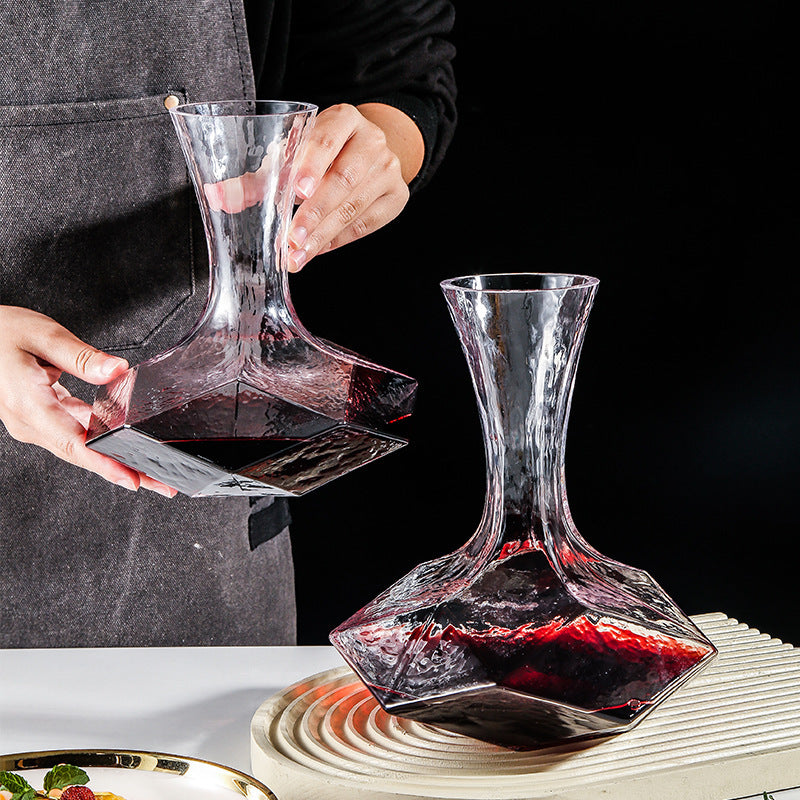
Brushes are often the wrong tool for Riedel shapes. Many Riedel decanters have a narrow neck that opens into a much wider base — the brush that fits through the neck can't reach the base chamber. Forcing a brush into an ill-fitting neck puts lateral pressure on the glass that can cause stress fractures over time. The bead method sidesteps this entirely: the beads pass through the narrow neck freely and work the wide base chamber without any pressure on the glass walls.
For a stained wine decanter that's been sitting for a long time: start with a cold water rinse to temperature-equilibrate the glass, then add room-temperature vinegar for a soak (no rice — the grains can lodge in narrow passages), then follow with a gentle bead swirl. Never combine heat with a stained Riedel — the thermal shock risk isn't worth the marginal cleaning boost.
The Final Step: How to Clean and Dry a Wine Decanter Without Water Spots
A perfectly cleaned decanter that's dried wrong ends up with white water spots from mineral deposits in tap water — which looks just as bad as tannin staining when you hold the glass to the light. Drying properly is the last step that most guides skip, and it's the difference between a decanter that's clean and one that looks clean.
The best method: invert on a drying stand. A decanter drying stand holds the vessel upside down at an angle, letting gravity drain the remaining water completely while air circulates through the interior. This eliminates the pooling water at the base that causes water spots and the moisture that leads to musty odors if the decanter is stored before it's fully dry. Drying stands are inexpensive, take up minimal space, and are included in most cleaning kits.
While the decanter is still slightly warm — not hot — polish the exterior with a clean microfiber cloth using light circular motions. The residual warmth helps the cloth lift any water droplets without smearing. A cold decanter polished with a microfiber cloth leaves streaks; a slightly warm one polishes to a clear finish in under a minute.
If you don't have a drying stand: prop the decanter upside down in a dish rack with the neck resting across the rack at an angle — it won't be perfectly inverted, but it's far better than right-side-up drying where water pools at the base. Never store a decanter while it still has moisture inside.
Decanter Cleaning Checklist
- ✓ Light stains: White vinegar + raw rice, swirl for 2–3 minutes, rinse thoroughly
- ✓ Deep or set-in stains: Vinegar soak for 10 minutes, then cleaning beads + swirl
- ✓ Intricate shapes (Riedel, swan-neck): Beads only — no brush, no rice, lukewarm water only
- ✓ Drying: Inverted on a drying stand until completely dry
- ✓ Exterior polish: Microfiber cloth while glass is still slightly warm
- ✗ Never: Dish soap inside the decanter, hot water on cold glass, or storing while still damp
Your Decanter Cleaning Questions, Answered
What is the best way to clean wine stains from a decanter?
Stainless steel cleaning beads with lukewarm water are the most effective method for deep wine decanter stains — they reach every surface regardless of the decanter's shape and lift tannin deposits without chemicals or scratching. For lighter stains on accessible shapes, white vinegar and raw rice is equally effective and costs nothing. The one thing to avoid in both cases is dish soap, which leaves a residue that affects the taste of the next bottle you pour.
Can I use dish soap to clean my decanter?
For the exterior, yes. For the interior — no. Dish soap leaves a micro-film on the inside of glass that doesn't fully rinse away, even after multiple rinses. This residue sits in the wine and affects its aroma, particularly in delicate whites and lighter reds where the soapy note is noticeable from the first pour. White vinegar, cleaning beads, and warm water clean the interior without leaving any flavor-affecting residue. This rule applies to wine glasses as well — soap on the inside of any vessel that touches wine is a mistake.
How often should I clean my wine decanter?
Rinse with lukewarm water immediately after every use — before the wine has a chance to dry and the tannins to bond with the glass. If you do this consistently, a deep clean with beads or vinegar is only needed every few uses, or whenever you notice a visible stain building up at the base. The most common cleaning problem is decanters that sit unused for weeks after a single rinse, which is when tannin residue sets hard and requires the more intensive bead method to remove.
How do I clean a wine decanter without a brush?
Cleaning beads or the vinegar-and-rice method both work entirely without a brush — which is actually an advantage for decanters with shapes a brush can't navigate. For any decanter with a narrow neck that opens to a wide base (the majority of quality decanters), a brush that fits through the neck physically can't reach the base chamber. Beads fit through the neck opening and work the full interior through the swirling motion. This is why the bead method is recommended for Riedel and other specialty shapes specifically.
How do I clean and dry a wine decanter without water spots?
Invert the decanter on a drying stand immediately after the final rinse and let gravity drain it completely. Once the water has drained and the glass is still slightly warm, polish the exterior with a microfiber cloth in light circular motions. The slight warmth helps the cloth lift residual water droplets cleanly rather than smearing them. Store the decanter only after it is completely dry inside — any residual moisture causes musty odors that transfer to the next bottle.
The bottom line: Two minutes with cleaning beads or a vinegar soak handles every stain scenario. No soap, no hot water, no brush forcing. Your decanter should be as clear as the day it arrived — and now you have the method to keep it that way.
Looking to upgrade your full wine setup? Our guide to wine accessories worth owning covers the best decanters, glassware, and storage tools that are worth the investment.